
Equity, Diversity and Inclusion Policy
What we mean by inclusion, what we actually do about it, and what we hold ourselves to.
Why we have this policy
Uphill skiing and splitboarding have been, and largely remain, expensive and socially closed. The equipment costs thousands of dollars, the knowledge is passed between people who already have it, and the culture rewards those who already look and sound like it. Inclusive Ski Touring exists because of that, and this policy is how we hold ourselves to it rather than talking about it.
Our principles
- Our fee is never the reason somebody sits out. On request, our fee is waived in full, with no questions asked, no explanation needed and no documentation. We do not means-test.
- We work on the cost of gear rather than leaving it to you. We have a rental partner at every location we run, at a rate we negotiated for our participants, which at Cranmore comes back as store credit.
- Not knowing anybody is never the reason somebody sits out. Every program day begins with introductions, and no-drop means the group waits.
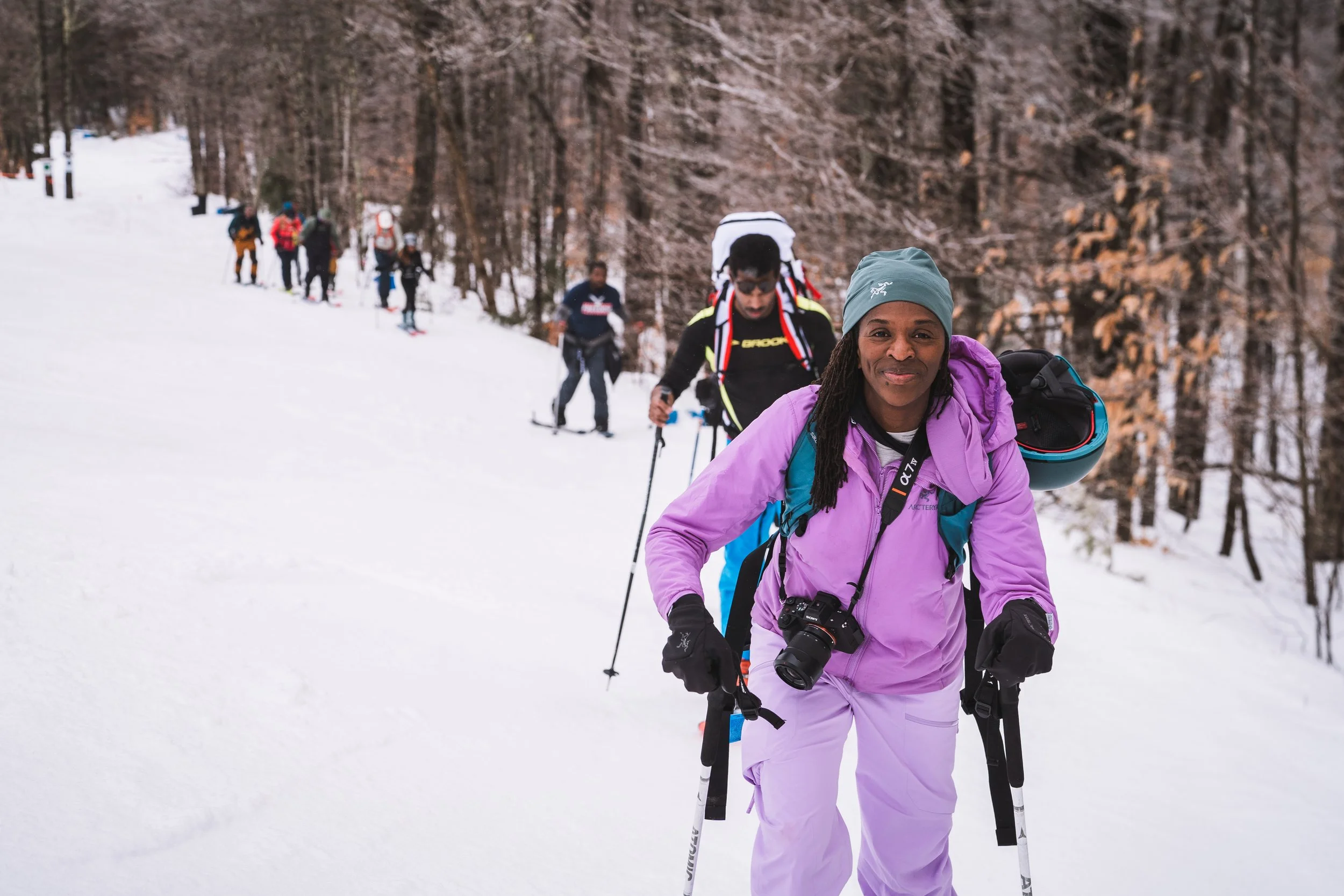
- People describe themselves. We use the words people use about themselves, we ask before we name anybody, and we ask again before we use their photograph.
- Participation is not inspirational. Our participants came to go touring. We show them as capable, ordinary athletes doing a normal thing, because that is what they are.
Affinity programs, and why we run them
We run days for women and nonbinary participants, for LGBTQ+ participants, for trans and nonbinary participants, for BIPOC participants and for people 40 and over, some of them in partnership with organizations rooted in those communities.
These exist because a mixed group is not a neutral space for everybody, and because the single most common thing participants tell us about an affinity day is that they did not have to explain themselves before they could enjoy it. We also run days open to everybody, at four mountains, every weekend of the season.
What this looks like in practice
- Volunteers are briefed that unsolicited technique advice is not welcome, and to ask before helping.
- Ability requirements are stated plainly on every program page, so nobody arrives at the wrong difficulty and has a bad day in front of people.
- Every guide and education page is free, because knowledge is a barrier we can remove at no cost.
- Anybody can ask not to be photographed, at any time, and nobody will ask them why.
- Programs are run at accessible price points and we publish exactly what we subsidize, so the commitment is checkable rather than stated.
What we are not, and will not pretend to be
We are not an adaptive sports program. We do not have adaptive equipment or adaptive instruction, and organizations that do exist and do it far better than we could. If you contact us about a disability we will tell you honestly what we can and cannot accommodate, and we will point you toward people who can help where we cannot. We would rather do that than take somebody's money and disappoint them.
We are also a small organization run mostly by volunteers, and our volunteer team does not yet look like the community we say we serve. That is a real gap and naming it is more useful than claiming otherwise.
Conduct on our programs
Harassment, discrimination and demeaning behavior toward anybody on the basis of race, ethnicity, national origin, religion, age, sex, sexual orientation, gender identity, disability or body size have no place on our programs and will end somebody's participation. Judgment about somebody's pace, fitness, gear or ability is included in that, and it is the version we see most often.
If something happens on a program, tell the volunteer or guide leading your group, or email info@inclusiveskitouring.org. We will take it seriously and we will tell you what we did.
Hiring and volunteering
We are an equal opportunity organization in hiring and in recruiting volunteers. We do not ask candidates for salary history and we do not run unpaid trial work. Our board recruitment aims to bring in people from the communities our programs serve.
Holding ourselves to it
We survey every participant and we publish the results, including the ones that are not flattering. In 2026, of the 135 people who answered, 100% said they felt welcomed, 98.5% said the program met their expectations and 94.1% said they would come again. We also planned 79 program days and ran 64, which is the number we are least happy with. The full picture is on our impact page.
This policy is reviewed by the Board annually.

