
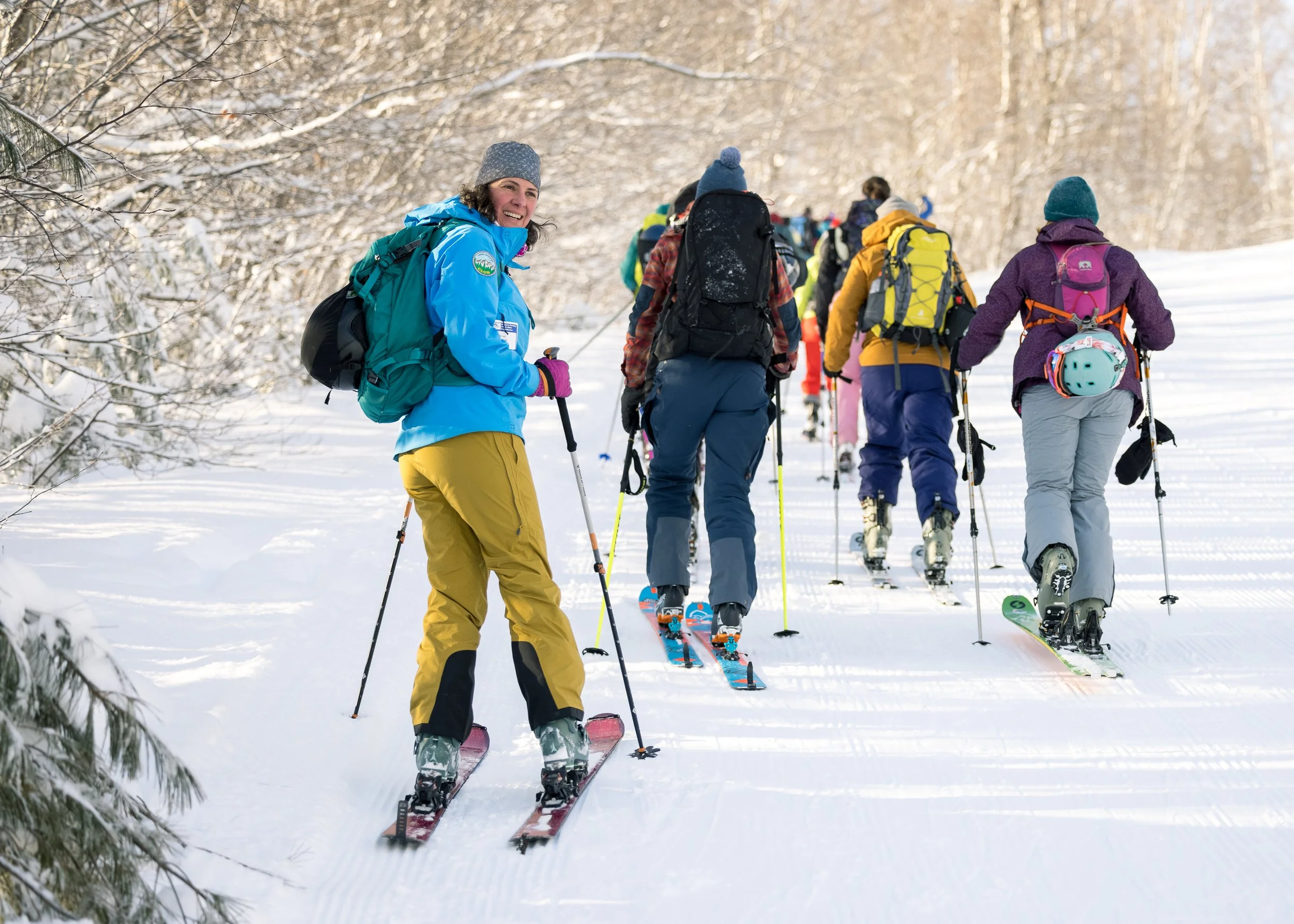
Packing guide
What goes in the pack, and what stays at home. Different for a resort uphill day and a guided backcountry day, so both lists are here, plus the avalanche gear question and an honest answer about when you actually need it.
The pack itself
20 to 30 liters with a waist strap. The waist strap is not optional, because a pack that swings on the descent is genuinely unpleasant and slightly unsafe. Bigger is not better: a 40 liter pack half empty rides badly.
Somewhere to carry skis or a board on the outside is useful and not essential for our programs. A dedicated touring pack has diagonal or A-frame carry straps, and you will want one eventually.
A resort uphill day, the whole list
- Water, at least a liter. More in spring.
- Food. A sandwich and something sweet beats three gels.
- Your insulating puffy layer.
- A spare pair of gloves.
- A warm hat and a buff.
- Sunscreen and sunglasses, and goggles for the descent.
- Phone, in an inside pocket so the battery survives the cold.
- Your uphill ticket or season pass, carried visibly.
- Skin wax or a small skin strap if you own them. Not essential.
That is genuinely it. No beacon, no shovel, no probe, no first aid kit, no headlamp for a morning program. A resort uphill route on a designated trail is not avalanche terrain, and adding equipment you do not need is how a cheap sport becomes an expensive one.
A guided backcountry day with us, what changes
- Everything above, plus more insulation. Mt. Washington makes its own weather and it is colder and windier than the valley by a large margin.
- More water and more food. This is a full day, not a half day.
- A headlamp. Not because we expect to be out late, but because it weighs nothing.
- A small personal first aid kit: blister bandages, tape, painkillers. Your guides carry the real one.
- Fully charged phone and, if you have one, a paper map of the area.
Beacon, shovel and probe are not required on our Intro to Backcountry programs, because those programs deliberately stay out of avalanche terrain.
Intro to Ski and Snowboard Mountaineering, the one course that requires avalanche gear
This is the exception, and it is the only one. Our Ski and Snowboard Mountaineering course goes into bigger terrain on Mt. Washington, so on that course you carry avalanche gear and technical gear as well as everything above:
- A beacon, a shovel and a probe. Required, not optional, and you need to know how to use them.
- Crampons.
- An ice axe.
You do not have to own any of it. Our fee for that course is $175, or $225 with the avalanche gear, the crampons and the ice axe included. Neither figure includes a touring setup, so skis or a splitboard, boots and skins are a separate rental of about $50 a day if you need them. One fully covered scholarship is available per program date and it covers the $175 fee only. Every other program we run, on resort or in the backcountry, requires none of this. The course page.
Avalanche gear, and when you actually need it
On our programs, one course requires it and nothing else does. Intro to Ski and Snowboard Mountaineering requires a beacon, shovel and probe, plus crampons and an ice axe, and the $225 option rents you that technical gear, though not a touring setup. Every on-resort day and every Intro to Backcountry day requires none of it, because those days stay out of avalanche terrain. That is the whole answer for anything you have booked with us. The rest of this section is about the days you go out without us.
The short version: you need a beacon, shovel and probe when you start traveling in avalanche terrain, and you need the education at the same time, not later. Owning the gear without the training is the most dangerous combination in this sport, because it produces confidence without competence.
Roughly 93 percent of people fully buried survive if they are recovered within about fifteen minutes, and roughly 30 percent survive beyond about thirty-five minutes. Nobody is arriving from outside in fifteen minutes. The only people who can find you are the people standing next to you, and only if they have practiced.
The full picture, including what an AIARE Level 1 covers and what it costs, is on the avalanche education page. If you take one thing from this section, take that link.
If you do own avalanche gear
Practice every three to four weeks during the season: a full beacon search, probe and shovel sequence somewhere safe. Most ski areas and avalanche centers run free or low-cost beacon parks. Twenty minutes, and it is the difference between owning equipment and being able to use it.
Batteries: fresh alkaline at the start of the season, and never rechargeables in a beacon, because their voltage curve makes the battery indicator lie to you.
What to leave at home
- Cotton anything.
- A big insulated resort jacket, unless it is all you own, in which case bring it and expect to carry it.
- An expedition parka. You are out for a morning.
- Two pairs of socks worn together. It makes your feet colder, not warmer.
- Your dog. Not permitted on our programs and not permitted on most uphill routes.

