
On-Resort Uphill Etiquette
Short version: single file on the edge, yield to everything coming down, and do not be the reason a mountain stops allowing uphill travel. The longer version is below and it takes four minutes to read. This page is about traveling uphill at a ski area. The backcountry is a different set of problems and a different set of answers.
This is about resort uphill travel
Everything on this page is about traveling uphill at a ski area, on trails somebody grooms, patrols and insures, with other people coming down them. That is why the rules are what they are: you are a guest on a working mountain.
The backcountry has different hazards and different courtesies, and none of the resort rules below transfer cleanly. Start with avalanche education and AIARE, then our guided backcountry days, where a professional guide takes you through it on the day.
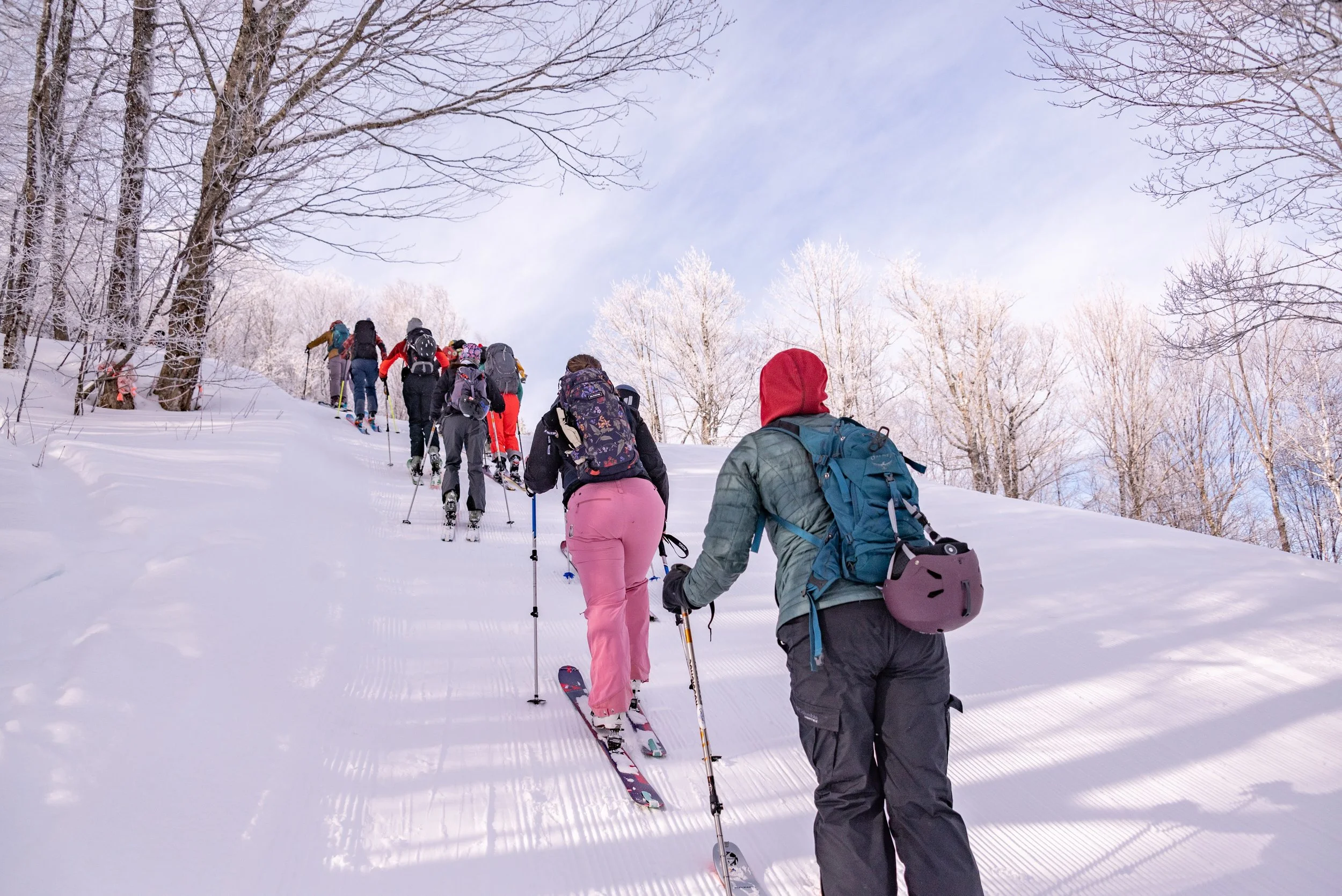
Stay to the side, single file
Walk up the edge of the designated route, on the skier's right where there is a choice, and go single file. Two people side by side on a skin track is how a group ends up taking the whole trail, and the whole trail is where somebody is about to come down at speed.
Do not walk up the middle of a groomed run. It leaves a set of ruts down the best snow, it is the single most common complaint resorts have about uphill travelers, and it is the thing most likely to get a policy tightened.
Yield to downhill traffic
Everything coming downhill has the right of way, always, without exception, including when they are in the wrong. You are the one who is stationary, visible and able to step aside. They are the one who is going twenty miles an hour on edges.
Step off the trail rather than to the edge of it if you need to stop for any length of time, and do not stop below a rise where nobody can see you until they are on you.
Closed means closed
A closed trail at a ski area very often means a winch cat is working. A winch cat runs on a steel cable anchored at the top of the slope, and the cable can be under the snow or sweeping across it. You cannot see it and you cannot get out of its way. This is the rule to never bend, and it is the reason resorts get firm about uphill policy.
Snowmaking is the other one. Guns are loud, they throw ice, and the visibility around them is zero. Go around, not through.
The social parts
The skin track is a friendly place and the norms are mostly obvious once somebody says them out loud.
- Say hello. It is a small community and you will see the same people all winter.
- If somebody behind you is faster, let them by. If you are faster, ask rather than pushing.
- If somebody is struggling, ask before helping. Offering to carry somebody's skis is sometimes kind and sometimes the worst thing you could say.
- Do not give unsolicited technique advice to strangers. This one comes up a lot and it is worth thinking about who tends to receive it.
- Pack out everything, including skin backing and the corner you tear off a bar wrapper.
Dogs, headphones and the small stuff
- Dogs. Not on our programs, and at most resorts not on the uphill route either. Check the specific mountain, because a few allow it at specific times.
- Headphones. One ear at most, and preferably none. You need to hear a snowmobile, a groomer, and somebody shouting behind you.
- Lights. If you are out at dawn or dusk, a headlamp facing forward and something reflective facing back. Grooming operators are looking for machinery, not people.
- Your uphill ticket or season pass. Carry it visibly. Patrol asking you for it and you not having it is how access gets reviewed. See uphill policies.
What changes in the backcountry
Almost all of the above still applies, and two things get added. First, you are responsible for the whole party, not just yourself, so nobody goes ahead out of sight and nobody gets left behind. Second, you are making terrain decisions that a ski patrol is not making for you, which is what avalanche education is for. On our programs, the guides make those calls and they will explain them as they go, because watching somebody decide is how you learn to decide.
The best single summary of uphill etiquette in our region is the Good Uphilling Guide, written by Uphill New England. It is worth reading once and it takes ten minutes.