
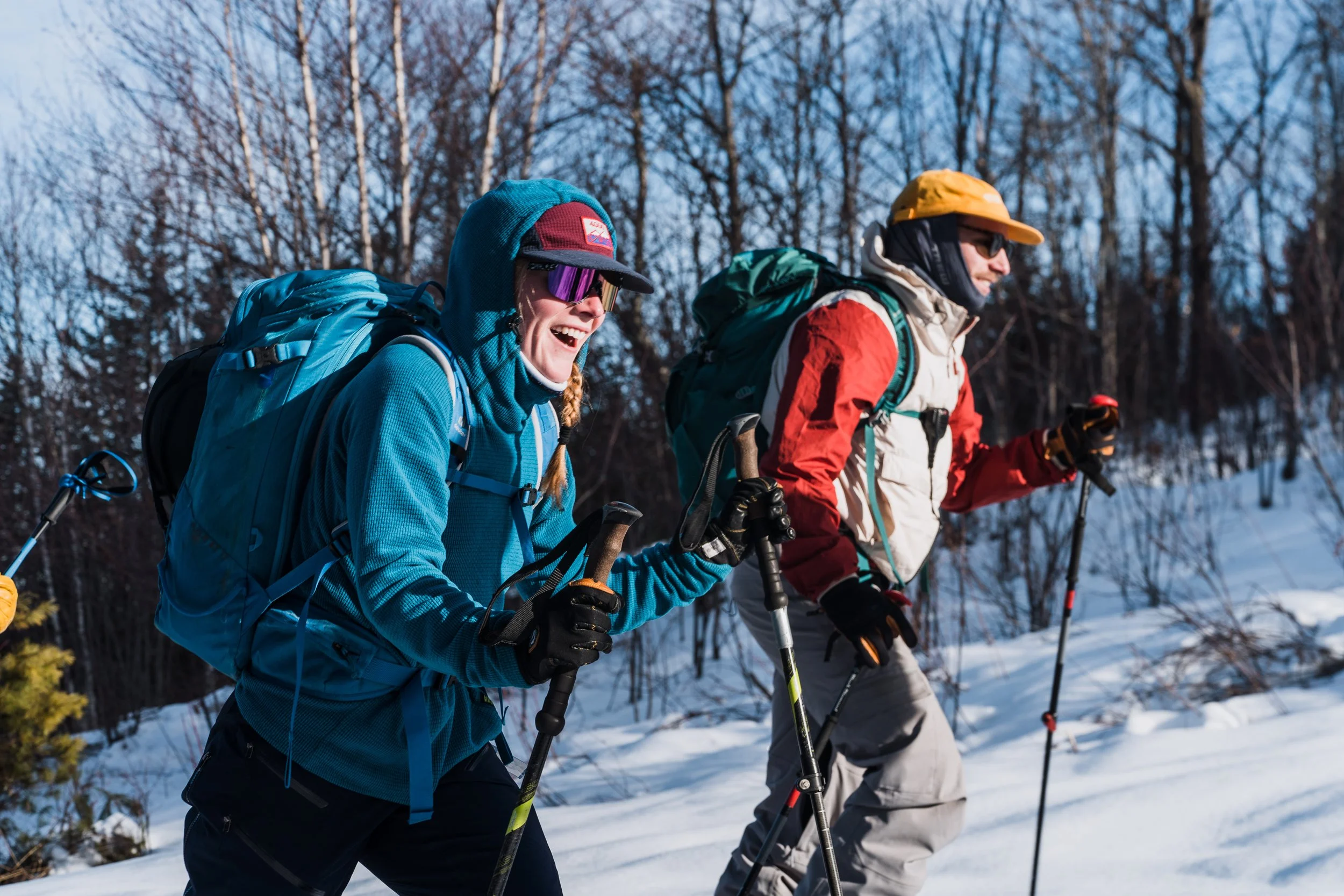
What to expect on a program day
We run two kinds of day and they are not much alike, so this page covers both, each from the parking lot to the parking lot. An on-resort day is a half day at a partner mountain for $25, $10 or free, led by trained volunteers, and it is where nearly everybody starts. A backcountry day is a fully guided day on Mt. Washington for $150, with professional guides and a real descent. Read the one you have booked.
Which one have you booked? If your confirmation email names a mountain, an on-resort fee of $25, $10 or free and a morning that finishes around noon, you want the on-resort day below. If it names Pinkham Notch, a $150 fee and a guide, skip to the backcountry day. If you are still choosing, see every program.
An on-resort day, $25, $10 or free
A half day of uphill touring at one of our partner mountains, on a route the mountain keeps open for people climbing under their own power. Our volunteers run it, the group stays together, and you ski down a trail everybody in the group can handle. The one thing we ask is that you can get yourself down a blue square trail. No uphill experience at all is needed. Most people who come have never toured before.
The week before
You will get an email from us confirming the date and the meeting point. If you need to rent gear, that is the week to book it, because rental shops run out on good weekends. See rentals and sizing. If you want help arranging a rental, reply to the email and say so.
The night before
Weather calls go out the evening before, so check your email. If we cancel, you are refunded in full. Lay your layers out and fill a water bottle. Read the layering guide once if you have not, because being dressed wrong is the most common way a first day goes badly and it is completely avoidable.
Arriving
Park in the main lot and come into the lodge. You do not need to find us in the parking lot, and you do not need to have your gear on. If you are renting from the mountain, rental pickup usually opens at 8:00am, so come for that first and then find us.
Buy your uphill ticket at the window if the mountain charges for one, or carry your Uphill New England season pass if you have one. A ticket is $15 at Mt.Abram and $19 at Cranmore, and there is nothing to buy at Dartmouth Skiway because Dartmouth gives our participants free uphill access. See uphill policies.
Check-in, 8:15am to 8:45am
Cranmore is the exception. Check-in there is 8:45am to 9:15am and we aim to be on snow by 9:30am, thirty minutes later than everywhere else. Your confirmation email has the times for your specific day, so trust that over this page.
We will have a table or a flag and somebody whose job is to say hello to you. You will give us your name, we will check you off, and somebody will help you get your skins on if you have never done it. There are cubbies at most of our mountains for your things.
This is the part people worry about most, so here is the truth of it: a lot of people arrive alone, most people have never done this, and the volunteers are there specifically to talk to you.
Getting on snow, 9:00am
We go outside and stand in a circle, and everybody says their name, their pronouns if they want to, what brought them, where they usually ski, and whether they have toured before. It takes five minutes and it is the moment the day stops feeling like an event and starts feeling like a group of people.
This is also why we tell you to dress to be comfortable rather than slightly cold: you are standing still outside for those five minutes before you generate any heat.
Going up
We set off about fifteen minutes after we get outside. The pace is set by the slowest person in the group, deliberately and without comment. We regroup where the trail flattens. Volunteers are spread through the group, not just at the front, and they will show you kick turns and fix your skins and tell you to use your risers.
We stop in the first five to ten minutes so everybody can take a layer off. That stop is planned, because you will be too warm by then and because we would rather you started the day comfortable than started it cold. Everybody uses it and nobody minds waiting. See the layering guide, which is written around this.
The top
Somewhere between about 10:15am and 11:00am depending on the mountain and the group. Put your insulating layer on before you cool down, then skins off, heels down, boots into ski mode. Allow about fifteen minutes. Somebody will talk you through it and somebody will check your bindings. There is usually a view and there is always a photo.
Going down
We ski down together as a group, on a trail everybody can handle. This is the part you already know how to do. You need to be able to get yourself down a blue square trail, which is the one thing we ask, because we are not downhill instructors and the descent is yours.
Afterwards
We finish at the bottom around noon, and there is time for questions and for swapping names with people. Plenty of people go and get lunch. Plenty of people who came alone leave with somebody to tour with, which is, honestly, the main thing this organization does.
A backcountry day on Mt. Washington, $150
A full day beyond the resort, on Mt. Washington, led by professional guides rather than by volunteers. There is no lift, no groomed trail and no lodge to come back into at the halfway point. It is longer, colder and steeper than an on-resort day, and it is the reason the requirement below is the one thing we are strict about.
The one hard requirement. You need to be comfortable and confident descending black diamond terrain on skis or a splitboard. We are strict about this because the John Sherburne Ski Trail is a real descent in variable snow and we are not downhill instructors. If you are not there yet, an on-resort day for $25, $10 or free is the right first step, and most people who come to a backcountry day have done one.
The week before
Your confirmation email names Pinkham Notch and the check-in time. If you need gear, book it that week: a backcountry setup is not something a resort rental counter always has, so tell us when you book and we will point you at the right shop. See rentals and sizing. Read the packing guide and the layering guide, both of which are written for this day specifically.
The night before
Mt. Washington makes its own weather and it decides this day, not us. Weather calls go out the evening before, so check your email. If we cancel, for weather or for any other reason, you are refunded in full. Pack a 20 to 30 liter pack with a waist strap, weather-appropriate layers, a helmet, water and food for the day, and more insulation than you think you need, because it is colder and windier up there than it is in the valley.
Arriving, and where
We meet at the Pinkham Notch Visitor Center, 361 New Hampshire Route 16, Gorham, New Hampshire 03581. There is parking, a building to stand inside and bathrooms. Give yourself more driving time than the map says in winter. If you want to stay nearby the night before, see lodging and accommodations.
Check-in, 9:45am
Your guides check you in, look over your pack and your layers, and answer the questions you have been saving up. Introductions happen here rather than on snow, because from the trailhead onwards we are walking. Nobody is graded on their gear at this table; if something is missing, the guides sort it out with you.
Going up, from the trailhead
We climb the Tuckerman Ravine Trail, about 2.4 miles with roughly 2,000 feet of gain, as far as the Hermit Lake shelters. Instruction starts at the trailhead and continues the whole way: skin technique, kick turns, pacing, layering, and reading the terrain you are walking through. The group moves at the pace of the group, the same rule as on resort. This is a longer climb than an on-resort route and the whole day is built around it.
Avalanche terrain, and what you do not need
This route deliberately stays out of avalanche terrain, and an Intro to Backcountry day is not an avalanche course. So on the day described above you are not required to own or carry a beacon, shovel and probe. That is on purpose: it lets you find out whether you love this before you spend a thousand dollars on safety equipment. If it is the education itself you want, that is avalanche education and AIARE, and we run an AIARE Level 1 course at a reduced rate.
One course is different. Intro to Ski and Snowboard Mountaineering goes into bigger terrain, and it does require a beacon, shovel and probe, plus crampons and an ice axe. Our fee there is $175, or $225 with that technical gear included. Neither figure covers a touring setup, which is a separate rental of about $50 a day, and a scholarship on that course covers the $175 fee only. If that is the day you have booked, read the course page and the packing guide, because the timings on this page are for an Intro to Backcountry day.
Going down
We descend the John Sherburne Ski Trail. It is a real descent in variable snow, which is why the requirement above exists, and your guides will pick the line and the spacing. Most groups are back between 1:00pm and 3:00pm in the afternoon, depending on pace and conditions.
What is included, and what is not
Included: professional guides, instruction from the trailhead up, and a group that moves at the pace of the group. Not included: rental gear if you need it, food, and getting yourself to Pinkham Notch. Our $150 fee is waived on request the same way our on-resort fee is, and there is one full scholarship for each Intro to Backcountry day. How that works.
The things people are actually worried about
These come up on both kinds of day. Where the answer is different, both answers are here.
What if I am the slowest person there
Then the group goes at your pace. That is what no-drop means and it is not a courtesy, it is the rule, on resort and in the backcountry alike. The most quoted piece of feedback we have ever received is from somebody who said they enjoyed the leave no person behind policy because they are usually the slowest person.
What if I do not know anybody
Most people arrive alone. On resort, the introductions at 9:00am exist precisely because of this, and the volunteers know who came on their own. On a backcountry day the introductions happen at check-in, before anybody starts walking.
What if I cannot afford it
Use the code inclusive at checkout and our fee is waived in full. Anyone can use it, no explanation needed. That is true of the on-resort fee and of the $150 backcountry fee, and there is one full scholarship for each Intro to Backcountry day. The code covers our fee only. Uphill access is the resort's own charge and rental gear is the shop's, and both are priced on the program page for that mountain. How that works.
What if I do not have the gear
We have a shop or rental partner at every location we run and we have negotiated a discounted rate there for our participants. Tell us when you book. A backcountry day needs a touring setup rather than a resort one, so say so early for those days. Rentals and sizing.
What if I have to turn around halfway
On resort, you turn around and a volunteer comes down with you. Nobody skis down alone and nobody has to explain themselves. On a backcountry day the same holds, and it is your guides who make that call with you, which is part of what you are paying them for.
What if the weather is bad
On resort we ski in most weather, and if it is genuinely unsafe we cancel the evening before and refund you in full. If nobody has registered by the Thursday before, we cancel to respect our volunteers' time. On Mt. Washington the weather decides the day rather than us: calls go out the evening before and a cancellation is refunded in full. If you need to cancel a backcountry day, 48 hours notice or more means a different date or IST credit, whichever you prefer, and inside 48 hours we cannot refund or reschedule, because the guide is booked and the spot can no longer be filled.
Can I bring my dog
No. Dogs are not permitted on our programs, and at most resorts they are not permitted on the uphill route either.

